Garrett Hardin was an ecologist and microbiologist at the Universit...
#### TL;DR
In this paper Garrett Hardin argues that some proble...
Garrett Hardin (1915-2003) was an ecologist and microbiologist at t...
Jerome Wiesner and Herbert York were science advisers to Presidents...
Tick-tack-toe has no winning strategy: if both players play well, t...
"The greatest good for the greatest number" sounds reasonable, but ...
This is the same argument in energy terms. A person needs about 160...
Adam Smith's "invisible hand" (1776) is the idea that people pursui...
This is the heart of the paper, and it's a calculation at the margi...
Economists call this a negative externality: a cost of your decisio...
William Forster Lloyd was a professor of political economy at Oxfor...
Pollution is the commons in reverse: instead of taking something ou...
Whether an act is harmful depends on how many people do it. A front...
This section shows what the paper was really about. Hardin argues t...
Hardin applies natural selection to ethics. If people are asked to ...
This is Hardin's solution, and it's less authoritarian than it soun...
The most important reply to this paper came from Elinor Ostrom. In ...


Pollution is the commons in reverse: instead of taking something out, people put something in. A factory that dumps waste in a river saves the full cost of treating it and shares the harm with everyone downstream. A pasture can be fenced and divided, but air and water can't, which is why pollution is usually handled with taxes and regulation rather than private property.
This section shows what the paper was really about. Hardin argues that a welfare state that supports every child removes the natural limit on family size, and he rejects a 1967 statement, signed by some 30 nations at the UN, that the size of a family must rest with the family itself. These views, and his later writing against immigration, are why Hardin is a controversial figure today.
This is Hardin's solution, and it's less authoritarian than it sounds. His examples are parking meters, taxes and laws against bank robbery: rules that limit everyone's freedom a little, that most people agree to, and that leave everyone better off. In 1994 Hardin said the paper should have been titled "The Tragedy of the *Unmanaged* Commons."
This is the heart of the paper, and it's a calculation at the margin. Adding one more animal gives the herdsman the full gain, $+1$. The cost of overgrazing, roughly $-1$, is shared by all $n$ herdsmen, so he bears only $-1/n$. His net gain is $1 - \frac{1}{n} > 0$ for any $n \geq 2$. Every herdsman does the same sum and reaches the same answer. **Each decision is rational on its own, and together they ruin the pasture.**
Garrett Hardin (1915-2003) was an ecologist and microbiologist at the University of California, Santa Barbara. This essay started as his presidential address to the Pacific Division of the American Association for the Advancement of Science in June 1968. It has since been reprinted in more than 100 books, making it one of the most reprinted articles ever published in *Science*.
The most important reply to this paper came from Elinor Ostrom. In *Governing the Commons* (1990) she studied Swiss alpine pastures, Japanese forests and Spanish irrigation systems that communities had managed sustainably for centuries, without private ownership or central control. Even the English commons Hardin had in mind usually limited how many animals each household could graze. Hardin's herdsmen never talk to each other; real ones make rules. **In 2009 Ostrom became the first woman to win the Nobel Prize in economics.**
Tick-tack-toe has no winning strategy: if both players play well, the game always ends in a draw. The only way to "win" is to change what winning means, by cheating or knocking over the board. Hardin's point is that some problems are like this: no invention fixes them, only a change in the rules or in values.
#### TL;DR
In this paper Garrett Hardin argues that some problems have no technical solution and can only be solved by changing the rules people live by.
His example is a pasture open to all: **each herdsman gets the full benefit of adding one more animal but bears only a small share of the damage from overgrazing, so every rational herdsman keeps adding animals until the pasture is ruined.**
The same logic applies to pollution. Hardin argues that appeals to conscience will fail and that the answer is *"mutual coercion, mutually agreed upon"* rules like taxes and parking meters that people accept because the alternative is ruin.
The paper gave a name to one of the most important ideas in economics and ecology, and it also provoked its best-known rebuttal: [Elinor Ostrom's](https://en.wikipedia.org/wiki/Elinor_Ostrom) Nobel-winning work showing that communities often manage shared resources well on their own. **In 2009 Ostrom became the first woman to win the Nobel Prize in economics.**
This is the same argument in energy terms. A person needs about 1600 kilocalories a day just to stay alive. Every calorie spent above that, on work, art, travel or music, is a calorie that could have kept another person alive. A population at its maximum size is one where all energy goes to survival, which is why Hardin concludes that the optimum population is less than the maximum.
"The greatest good for the greatest number" sounds reasonable, but it asks for two maxima at once. In general you can't maximize two variables at the same time: push the number of people $N$ to its maximum and each person is left at bare subsistence, so well-being per person can't also be at its maximum. **You have to choose what to maximize, and that choice is a value judgment, not a scientific one.**
Garrett Hardin was an ecologist and microbiologist at the University of California, Santa Barbara. This essay started as his presidential address to the Pacific Division of the American Association for the Advancement of Science in June 1968. It has since been reprinted in more than 100 books, making it one of the most reprinted articles ever published in *Science*.
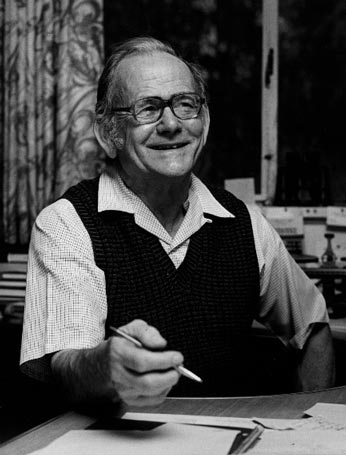
Adam Smith's "invisible hand" (1776) is the idea that people pursuing their own interest end up serving the common good, the way a baker baking bread for profit ends up feeding the town. The tragedy of the commons is the case where the invisible hand fails: what is best for each person is bad for everyone.
Another interesting read on Fermat's Library: [Of the Principle which gives occasion to the Division of Labour](https://fermatslibrary.com/s/of-the-principle-which-gives-occasion-to-the-division-of-labour)
Jerome Wiesner and Herbert York were science advisers to Presidents Kennedy and Eisenhower. Their 1964 *Scientific American* article argued that building more nuclear weapons was making both the US and the USSR less secure, since every buildup was matched by the other side. Hardin borrows their conclusion, "no technical solution", and builds the whole essay around it.
William Forster Lloyd was a professor of political economy at Oxford. In his 1833 *Two Lectures on the Checks to Population* he used an overgrazed common to argue about population growth, the same move Hardin makes here 135 years later. Hardin's contribution was the name and the audience.
Economists call this a negative externality: a cost of your decision that falls on someone else. Arthur Pigou described it in 1920 and proposed taxing it, so that people pay the full cost of what they do. Hardin never uses the term, but this is exactly what he is describing.
Whether an act is harmful depends on how many people do it. A frontiersman dumping waste in a river harmed no one; the same act in a city of millions is pollution. Fixed rules like "thou shalt not" can't keep up with that, which is why Hardin argues we need agencies that adjust the rules as conditions change.
Hardin applies natural selection to ethics. If people are asked to have fewer children out of conscience, those who listen have fewer children and those who don't have more. Over generations the population shifts toward people who ignore the appeal. **A rule that relies on voluntary restraint selects against the people who follow it.**